
GEO vs SEO 2026: The Complete NZ Guide for Auckland Businesses

Here's what most AI search articles won't tell you: for 80% of New Zealand businesses, traditional SEO still delivers ten times more leads than any AI optimisation strategy. The hype around GEO (Generative Engine Optimization) is real, but the numbers don't yet match the noise.
That doesn't mean you should ignore AI search. ChatGPT processes over 1 billion queries per week globally. Google's AI Overviews now appear on roughly 30% of informational searches. Your customers are using these tools, and the businesses that show up in AI-generated answers are building a compounding advantage.
The question isn't whether SEO or GEO matters. Both do. The question is where your budget goes first, and how much of it.
This comparison breaks down both strategies honestly — what they cost, how long they take, where they work, and where they don't — so you can make a decision based on your business, not on hype.
Not sure where your business stands? Get a free AI search audit — we'll check your visibility across Google, ChatGPT, and Perplexity and tell you exactly where the gaps are.
SEO vs GEO: What Each Strategy Actually Does
Before comparing, it's worth being precise about what these terms mean in practice. The marketing industry loves renaming things, and GEO gets confused with local SEO, AIO (AI Optimization), and half a dozen other acronyms.
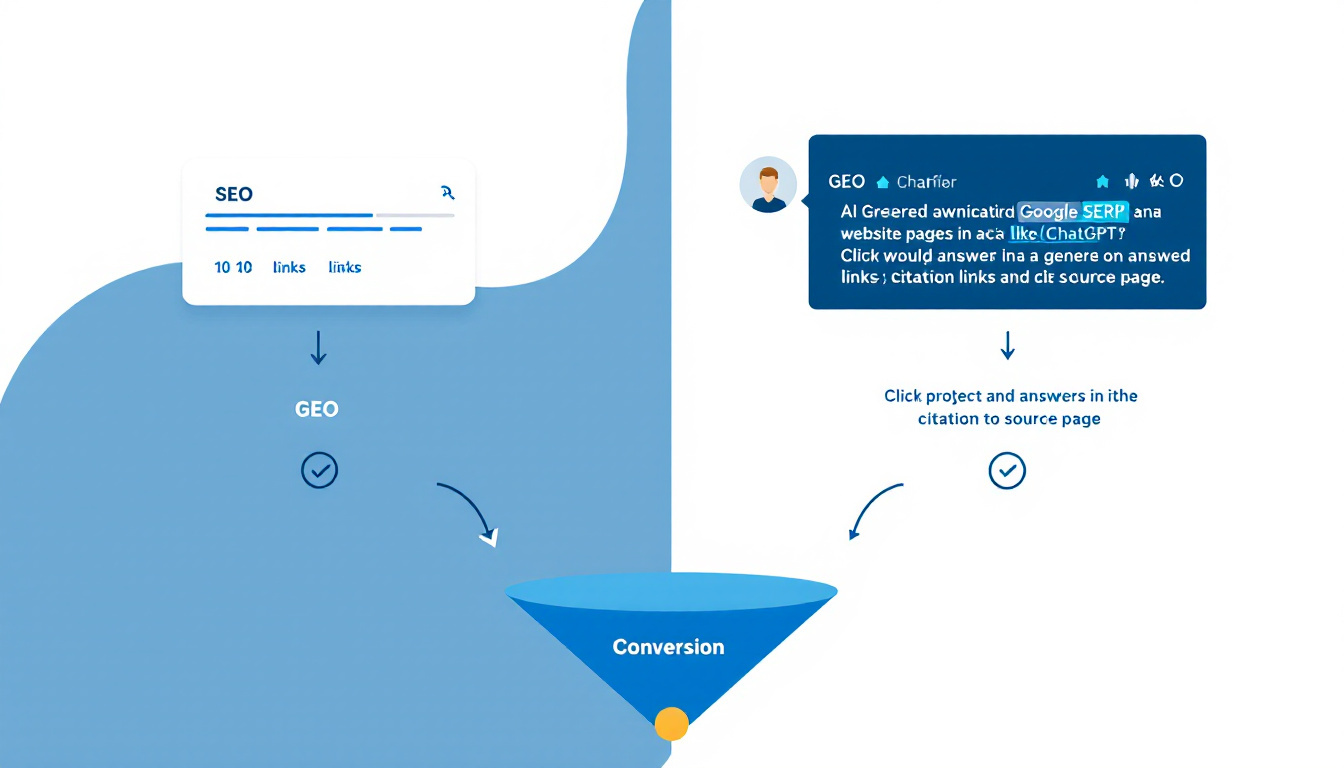
SEO targets Google's traditional search results — the ten blue links (plus maps, images, and featured snippets). You optimise pages to rank higher, earn clicks, and convert visitors on your website. The user journey is: search → click → visit your site → enquire.
GEO targets AI-generated answers from platforms like ChatGPT, Google AI Overviews, Perplexity, and Claude. You optimise content so AI models cite your business in their responses. The user journey is: ask AI → read answer with your brand mentioned → visit your site (or contact you directly).
The fundamental difference is who controls the presentation. In SEO, you control your search listing and landing page. In GEO, the AI decides how to present your information. You influence the input; the model controls the output.
Head-to-Head: SEO vs GEO for NZ Businesses
Here's an honest comparison across the metrics that matter for decision-making. These numbers reflect what we see across our NZ client base in 2026 — your results will vary by industry, but the relative differences hold.
| Factor | SEO | GEO |
|---|---|---|
| Traffic volume (2026) | 80-95% of organic discovery | 5-15% and growing |
| Time to results | 3-6 months for competitive keywords | 2-4 months (AI models update faster) |
| Monthly cost (NZ) | $1,000-$5,000 | $500-$1,500 (as add-on to SEO) |
| Measurability | Excellent (GSC, GA4, rank tracking) | Limited (no official analytics from AI platforms) |
| Control | High — you own your pages | Low — AI decides what to cite |
| Local relevance | Strong (Google Maps, local pack) | Improving (ChatGPT added location awareness in 2025) |
| Competition in NZ | High — most businesses do some SEO | Low — fewer than 5% of NZ businesses optimise for AI |
| Best for | Service pages, transactional intent | Informational queries, brand authority |
The standout insight from this table: GEO competition in New Zealand is still extremely low. Fewer than 5% of NZ businesses are actively optimising for AI search. That's a window of opportunity, but it doesn't override the fact that SEO still drives the vast majority of actual leads.
Where SEO Wins (and Where It Doesn't)
SEO remains the dominant channel for one reason: intent. When someone searches "plumber Auckland emergency" or "SEO company NZ," they're ready to act. Google's traditional results capture this commercial intent better than any AI tool currently does.
SEO strengths:
- Captures high-intent commercial searches ("buy," "hire," "near me")
- Google Maps and local pack dominate mobile search for service businesses
- Fully measurable — you know exactly which keywords drive which leads
- Compound returns — a page that ranks today keeps earning traffic for years
- Mature ecosystem — proven frameworks, reliable tools, experienced agencies
SEO limitations:
- Increasingly competitive — first-page rankings take serious investment in established markets
- Google's AI Overviews are pushing organic results further down the page
- Algorithm updates can wipe out months of progress overnight
- Younger demographics are shifting discovery behaviour toward AI tools
For most NZ service businesses — tradies, lawyers, accountants, health providers — SEO is still the engine that fills the pipeline. If you're not on page 1 for your core service keywords, that's where your money should go first.

Where GEO Wins (and Where It Doesn't)
GEO's advantage is visibility in a channel where almost nobody is competing yet. When ChatGPT recommends three SEO companies in Auckland and your competitor is one of them, that's a referral you can't buy through Google Ads.
GEO strengths:
- First-mover advantage — NZ competition is near zero in most industries
- Brand authority — being cited by AI carries implicit trust
- Captures informational queries that SEO can't monetise well ("how does SEO work")
- AI search usage is growing 40%+ year-on-year globally
- Content improvements for GEO also benefit traditional SEO (structured data, clear answers, authoritative citations)
GEO limitations:
- Traffic volume is still a fraction of Google — 5-15% at best in NZ
- No reliable analytics — you can't track "AI impressions" the way you track Google rankings
- AI models can hallucinate or misrepresent your business
- The landscape changes fast — what works in ChatGPT today may not work in six months
- Harder to attribute leads — "I asked ChatGPT" doesn't show up in GA4
GEO works best as a complement to SEO, not a replacement. The NZ businesses seeing results from GEO are the ones who already have strong SEO foundations — authoritative content, good backlink profiles, and clear topical expertise.
The Decision Framework: Which Strategy Fits Your Business?
After working with NZ businesses across both strategies, here's the framework we use to recommend where to invest. Be honest about where your business sits today — not where you want it to be.
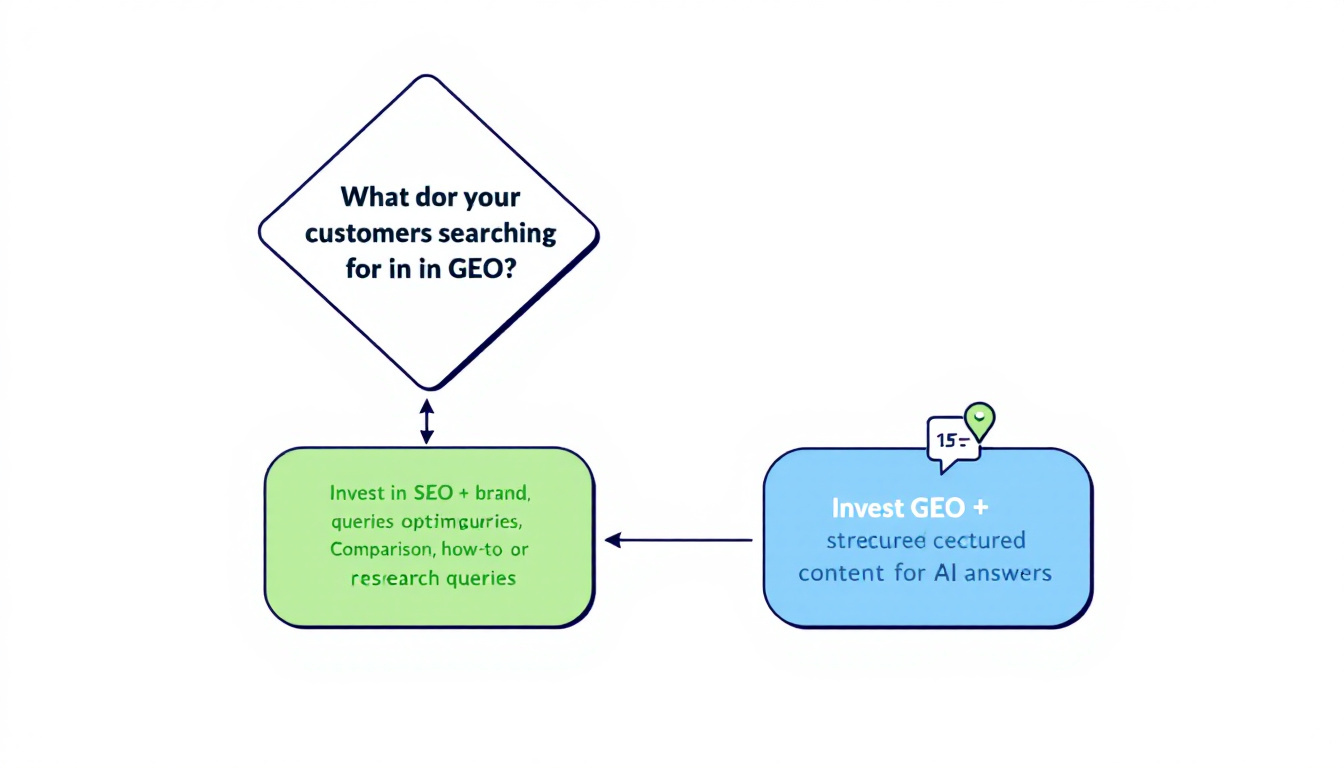
Invest in SEO first if:
- You don't rank on page 1 for your primary service keywords
- Your Google Business Profile isn't optimised or generating reviews
- You have fewer than 20 pages of content on your website
- Your website is older than 3 years and hasn't been technically audited
- You need leads this quarter, not next year
Add GEO to your strategy if:
- You already rank on page 1-2 for your core keywords
- Your competitors are appearing in ChatGPT and Perplexity answers
- You're in an industry where customers research heavily before buying (B2B, professional services, high-ticket trades)
- You produce regular content (blog posts, guides, case studies)
- You want to build brand authority for the next 3-5 years
Run both simultaneously if:
- You have $3,000+/month marketing budget
- Your SEO is already delivering consistent leads
- You're in a competitive market where differentiation matters (Auckland legal, Auckland trades, nationwide professional services)
Most NZ businesses should start with 80% SEO and 20% GEO, then shift the ratio as AI search matures. The good news: much of the content work overlaps.
What a Combined SEO + GEO Strategy Looks Like in Practice
For an Auckland service business spending $3,000/month on digital marketing, here's how a realistic combined strategy breaks down.
SEO (70-80% of budget, ~$2,200/month):
- Technical audit and fixes (month 1-2)
- Core service page optimisation — title tags, schema markup, internal linking
- Monthly blog content targeting commercial keywords (1-2 posts)
- Local SEO — Google Business Profile, citations, review generation
- Link building — 3-5 quality backlinks per month
GEO (20-30% of budget, ~$800/month):
- AI visibility audit — check citations across ChatGPT, Gemini, Perplexity, Claude
- Content restructuring — add clear, quotable answers to existing pages
- FAQ expansion — target the exact questions AI tools pull from
- Authority signals — statistics, original research, expert quotes that AI models prefer to cite
- Monthly monitoring — track brand mentions in AI responses
The overlap is significant. Structured content that helps AI tools understand your business also helps Google rank your pages. Well-executed GEO improves your SEO, and vice versa. The businesses that treat them as separate silos waste budget; the ones that integrate them see both channels accelerate.
What NZ Businesses Are Getting Wrong About AI Search
Three misconceptions we hear every week from NZ business owners:
"AI search will replace Google." Not in 2026, and probably not in 2027. Google processes 8.5 billion searches per day. ChatGPT processes roughly 150 million. AI search is growing fast, but it's additive — it's a new channel, not a replacement. Businesses that abandon SEO for GEO are trading proven revenue for speculative visibility.
"My SEO agency is already doing GEO." Ask them specifically what GEO work they're doing. If the answer is "we write good content" or "our SEO covers that," they're not doing GEO. Genuine GEO work involves AI-specific audits, citation monitoring, and content structured for machine comprehension — not just human readability.
"GEO is too expensive for a small business." The incremental cost of adding GEO to an existing SEO program is modest — typically 20-30% more. If you're already paying for content and technical SEO, the GEO layer leverages that existing investment. The businesses that can't afford GEO are usually the ones that can't afford to ignore it — their competitors are already showing up in AI answers.
How GEO + SEO Plays Out in Auckland, Wellington, and Christchurch
The strategy mix depends on your city's competitive density:
Auckland (most competitive): SEO competition is fierce — service categories like trades, lawyers, and agencies typically have 50+ businesses fighting for page 1. GEO becomes a differentiator here precisely because traditional SEO is already saturated. We see Auckland businesses with strong SEO foundations getting cited by ChatGPT and Perplexity within 2-3 months of starting GEO work, and that visibility translates into measurable brand search uplift in GA4.
Wellington: Mid-density market with stronger B2B and government-services concentration. Wellington legal, consulting, and tech businesses see particularly high ROI from GEO because their buyers research more before contacting — exactly the kind of long-form research behavior AI tools are built for.
Christchurch: Less crowded SEO market. Most local searches are still won through traditional Google + GBP optimisation. GEO is a "while you're at it" investment here — set it up alongside SEO rather than as a separate workstream.
Regional NZ (Dunedin, Tauranga, Hamilton, etc.): AI search penetration follows urban patterns, so the relative weight is the same as Christchurch — focus on SEO + GBP first, layer GEO when content infrastructure is in place.
The 2026 GEO Cluster: Related Reading
This guide is the entry point to our full GEO knowledge base. For deeper dives into specific aspects:
- GEO: What Is Generative Engine Optimization and Why It Matters in 2026 — the canonical definition + 2026 NZ data
- How to Get Your Brand Recommended by AI in 2026 — the 3-layer GEO playbook (search-driven, training-data, AI Overviews)
- GEO vs SEO: A Plain-English Introduction — start here if you're new to AI search
- Google's AI Search Is Here — Is Your Website Ready? — AIO-specific readiness checklist
- Is SEO Still Enough in the Age of AI Search? — when to make the GEO investment
- From SEO to GEO: Why Generative Engine Optimization Matters — strategic context
- A Deep Dive into Generative Engine Optimization — extended technical reading
Frequently Asked Questions
What is the difference between SEO and GEO?
SEO targets traditional search results where users see a list of links. GEO targets AI-generated answers from tools like ChatGPT, Google AI Overviews, and Perplexity, where the AI cites your content directly in its response rather than linking to a search result.
Should my NZ business invest in SEO or GEO first?
Start with SEO if you don't already rank on page 1 for your core service keywords. SEO delivers measurable traffic and leads today. Add GEO once your SEO foundation is solid — typically after 6-12 months of consistent SEO work. Most NZ businesses in 2026 should be running both, with SEO taking 70-80% of the budget.
How much does GEO cost compared to SEO in New Zealand?
SEO in NZ typically costs $1,000-$5,000 per month depending on competition and scope. GEO adds 20-30% to that budget for content restructuring, citation optimisation, and AI visibility monitoring. A combined SEO + GEO strategy for a competitive Auckland service business runs $2,000-$6,000 per month.
Can GEO replace traditional SEO?
No. As of 2026, AI search tools account for roughly 5-15% of total search traffic in most NZ industries. Traditional Google search still drives 80%+ of organic discovery. GEO is additive — it captures a new channel — but it cannot replace the volume that SEO delivers through Google's standard results.
How do I know if AI search tools are recommending my competitors?
Ask ChatGPT, Google Gemini, and Perplexity the questions your customers ask — like "best SEO company in Auckland" or "top plumber in Wellington." If competitors appear in AI answers and you don't, that's traffic you're missing. HornTech's AI search audit checks your visibility across all major AI platforms.
What does a GEO SEO agency in Auckland actually do?
A GEO SEO agency combines traditional Google SEO with optimisation for AI-generated answers from ChatGPT, Gemini, Perplexity, and Google AI Overviews. The work overlaps significantly — both rely on authoritative content, clear structure, and topical depth — but GEO adds AI-specific tactics like citation monitoring, FAQ schema for AI parsing, and content restructured around how AI models retrieve and synthesise information. In Auckland in 2026, fewer than 5% of agencies offer genuine GEO work; most are still selling traditional SEO under a new label.
How do I find a GEO SEO agency that knows what they're doing?
Three questions to filter agencies: (1) Can they show you specific examples of their clients being cited in ChatGPT, Perplexity, or Google AI Overviews? (2) Do they monitor AI citations as a deliverable, not just rankings? (3) Do they have a content restructuring methodology specifically for AI consumption (FAQ schemas, semantic anchors, quote-friendly answer blocks)? If they can't answer all three concretely, they're doing SEO with GEO branding.
Want to see where your business stands in AI search? Request a free AI search audit — we'll check your visibility across Google, ChatGPT, Perplexity, and Gemini, then show you exactly what to fix first.